BACK
BACK
FORdPRO | Upfit Integration System
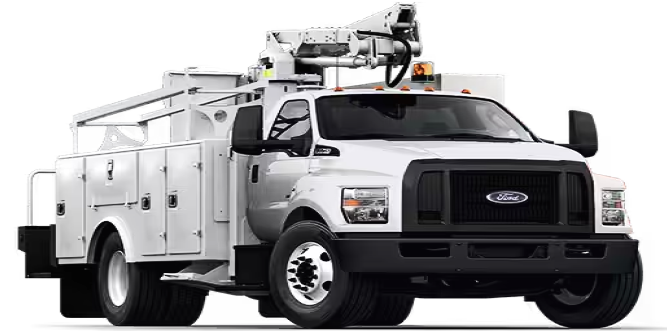
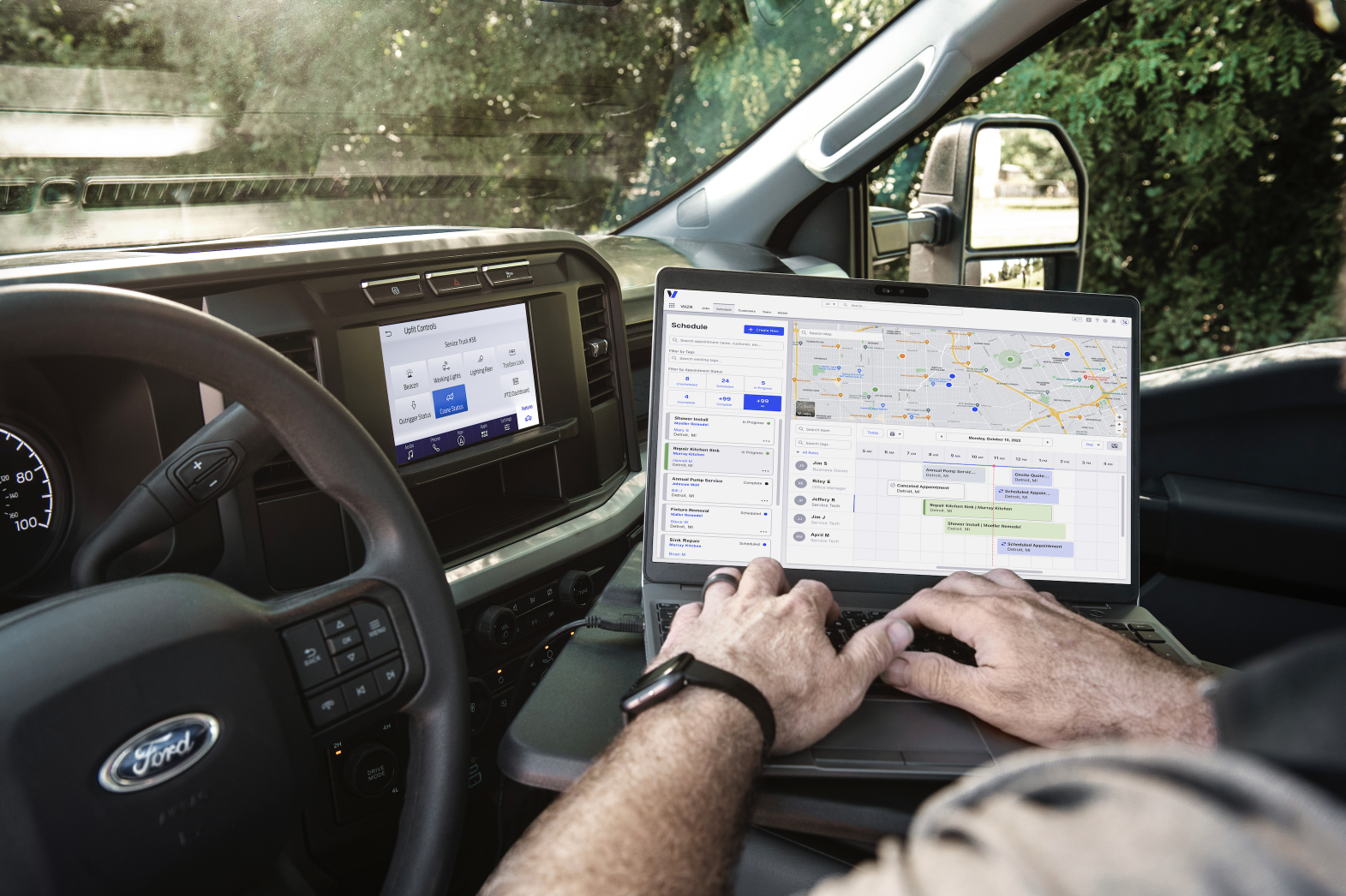
The Upfit Integration System (UIS) may not have the most exciting name, but it represents a huge leap for vehicle conversions within the automotive industry.
Ford has introduced this new UIS system to streamline and standardise the upfitting process, making it easier and more efficient to upfit and convert Ford vehicles.
My Role
Workstream Design Lead
Key Skills
Service Design, CX, Research, Product Delivery
Upfit - Verb
To customise a product (especially a vehicle) by adding extra features
UpfitTER - NOUN
a business (or individual) that specialises in upfitting vehicles in order to make them more useful for a specific purpose
Introduction
What is the upfit integration system?
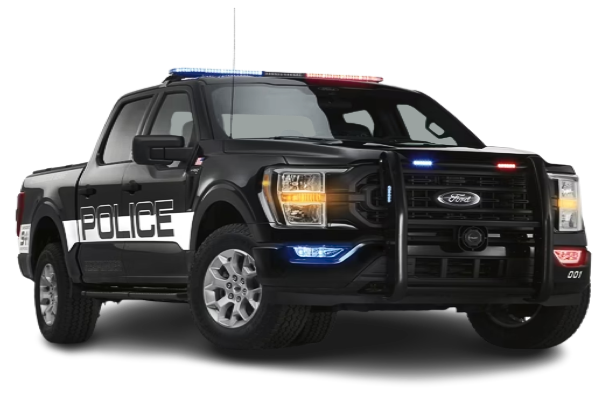
Think of a police vehicle. It needs to jam packed full of the latest technology, modifications and accessories to in order for police officers to do their demanding job day and night. That vehicle would have actually originally started off it's life as a stock vehicle rolling off the production line ready for a typical life on the road. This is exactly where the upfit journey begins. An Upfitter would have ordered that stock vehicle and had it delivered to their garage before the wheels had even really had the chance to touch the road. Then begins the complex and sometimes lengthy process of safely modifying the vehicle to suit the exact needs of their client (in this case a police force).


Before
After

Before UIS, Upfitters have had to use outdated and complex third-party software to program various features on upfitted vehicles, such as lights, sirens, plows, and cranes. This was a time-consuming and expensive process, and it often led to compatibility issues. Not only that, but 9 times out of 10 an Upfitter would invalidate the vehicle warranty by been forced to make modifications around the existing vehicle architecture. Here's where UIS comes in. UIS allows Upfitters to connect physically and digitally to the vehicles architecture at ease. No need to cut and hack physical properties anymore, plus there is now an open invite to integrate with the previously locked down digital systems of the vehicle.
My Role
12 weeks to launch. We need help!
I was brought into this FordPro program at a critical point in its 5 year build up — with only 3 months to go into the global launch of a series of vehicles lines and critical supporting technologies & services.
My key Responsibilities
1. Scoping & leading the project
I was charged with scoping and leading a Human-centred Design project aiming to assess the status of the various customer support products, processes & services prior to launch
2. Build & lead a team
It was my role to build and manage a small team of multi-disciplinary designers that would be able to complete the work.
3. Workstream Design lead
Lead the team to identifying any support issues in the end-to-end experience and deliver short term and long term recommendations & solutions back to the business in time for launch.
The problem
We need to know if we've missed something...
The release of the 2023 Ford Super Duty, one of the top-selling vehicles in the United States, was just around the corner. However, issues within the program had begun to surface, raising questions as to whether the service would be ready for launch.
Combining an ambitious backlog of promised features to deliver with a growing list of bugs inevitably added pressure to an already stretched team.
This was the point that I joined the project, and after finding out that the quality of experience was at risk I raised a major alert after also finding out an epic of work had yet to even be defined — post sales support.
So we had 3 months to go with an unstable service with an unknown (potentially non existent) support plan in place. As soon as possible I formed a Central Question, scoped the project and worked with the Lab Directors to approve building a workstream to focus in on customer support.
Central question
How might we provide easy access to practical and efficient support solutions for anyone that interacts with UIS upfitted vehicles
The team
Lean, nimble and laser-focused
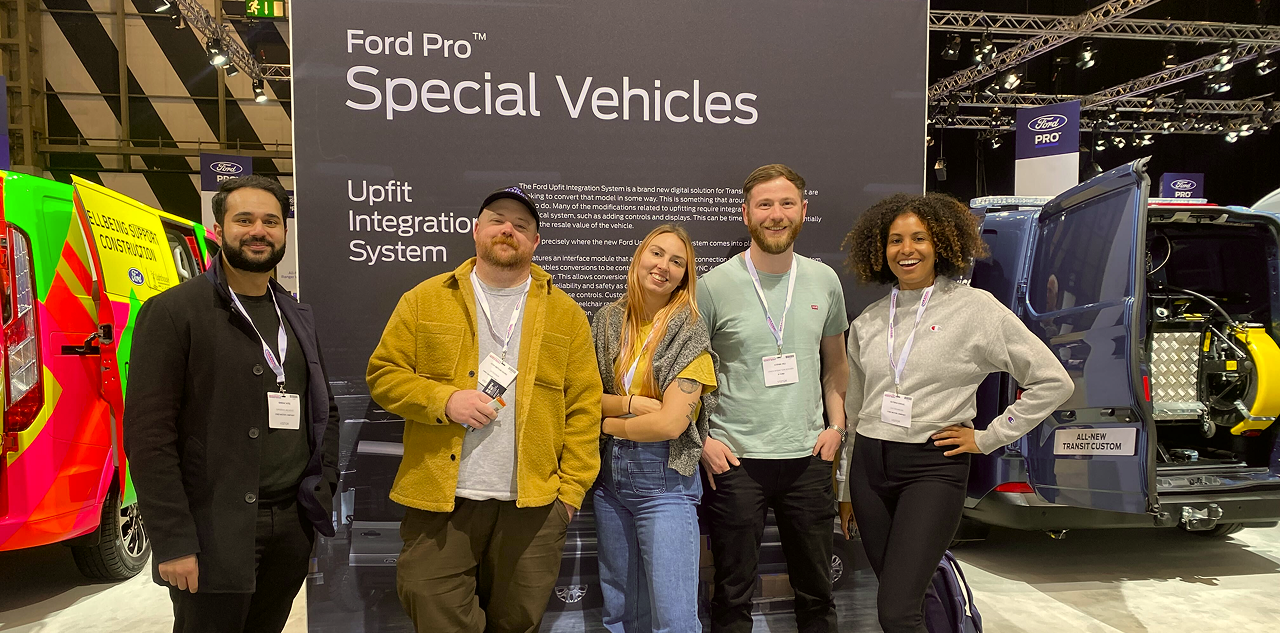
The team composition I was looking for was a lean multidisciplinary team with a weighting towards Service Design & Research. A team small enough to easily manoeuvre across various parts of the business and work quickly.

1 x
Service DesignER
(Me)

1 x
Design ResearchER
(contract)

1 x
Product DesignER
(FordPRO)
The plan
Our 4 core objectives
1. Map current experience
Identify areas where the end-to-end experience falls short and determine where support could be most needed at launch
2. Investigate business readiness
Understand & document UIS stakeholders and their existing knowledge & expectations for UIS support.
3. Confirm user needs
Determine the type of support the would best fit user behaviours and B2B support expectations.
4. Problem identification & solution proposals
Identify and prioritise any issues found and propose both near & far solutions. Near issues to be picked up as a priority before launch and far to act as a north star for the business.
Review current experience
What does now look like?
The first step was to understand and map out the service as it existed NOW.
This meant a thorough review and documentation of all of the actors, teams, artefacts, tools, processes, channels & touch-points across the end-to-end Upfitting journey.
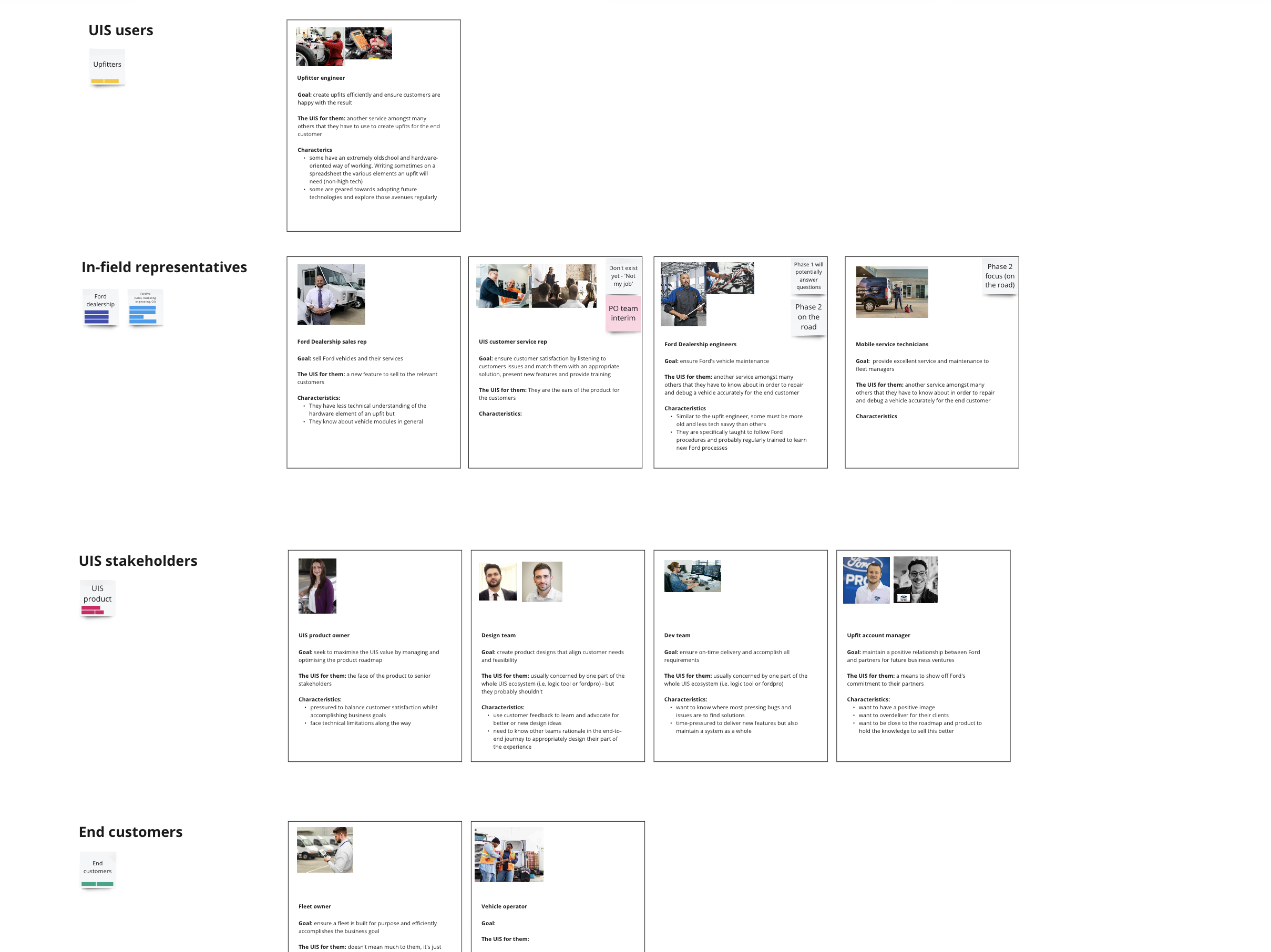
Front & back stage actor mapping
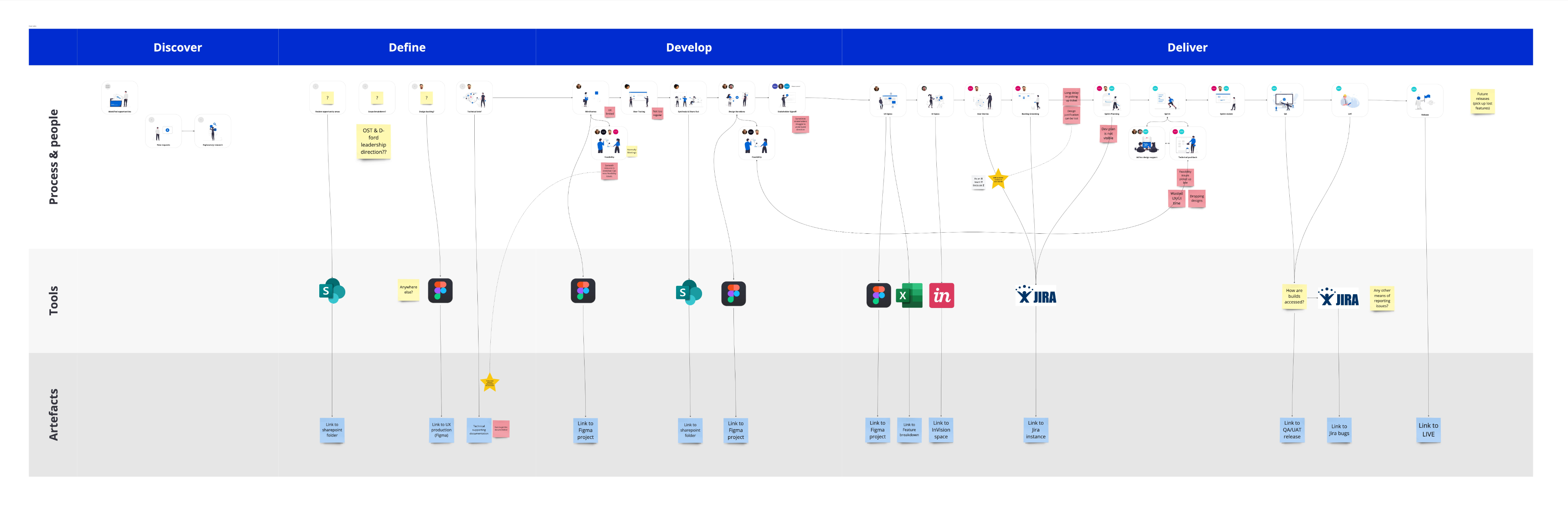
Product delivery process
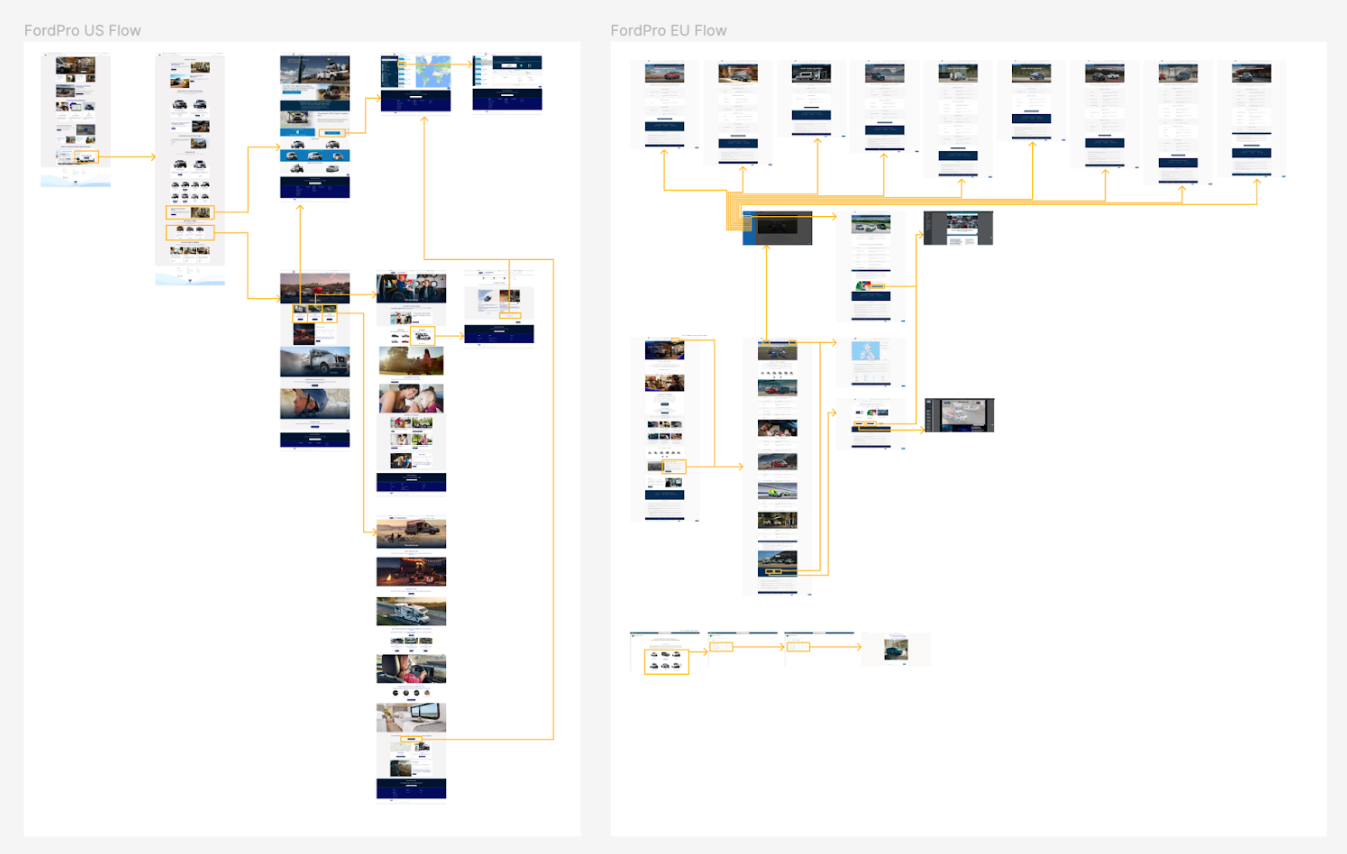
Web channel audit
Problem Discovery
Mapping support scenarios
After getting a base understanding of the end-to-end service and the people involved, the next activity was to try and map out where it could all go wrong!
Putting ourselves in the shoes of the various actors involved in the journey, we plotted potential pain points/questions with prior insights and questions that the team still had.
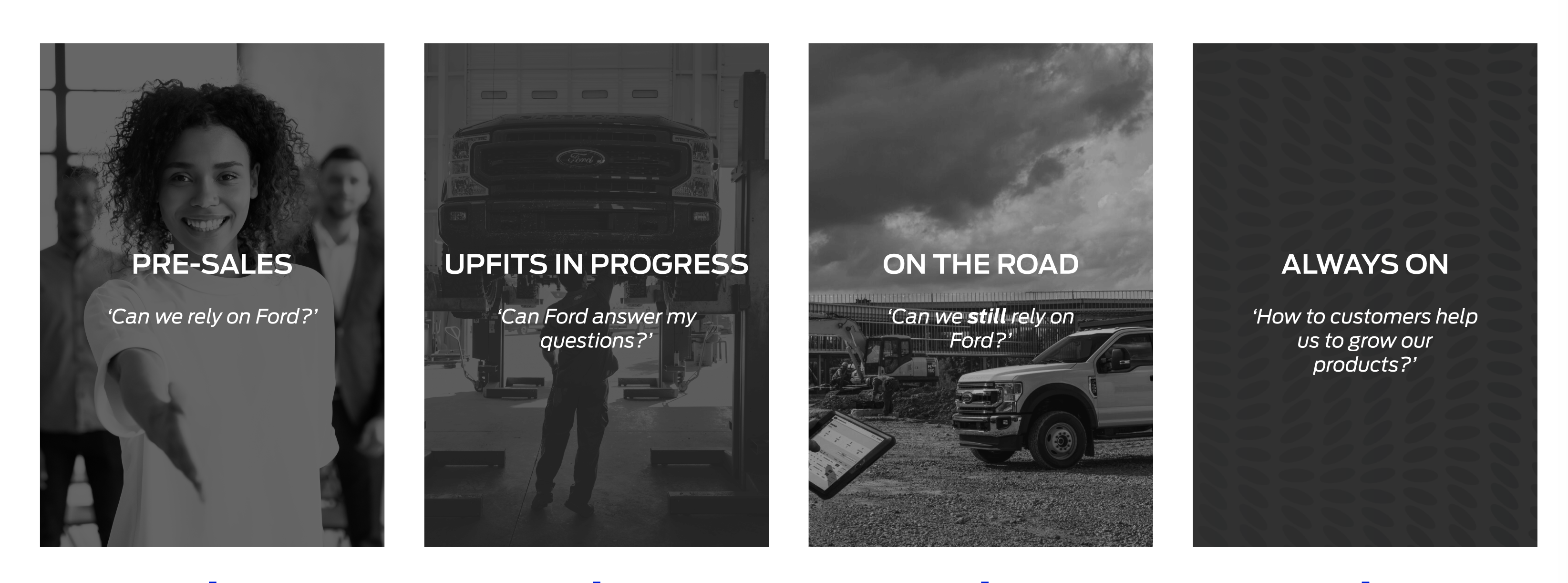
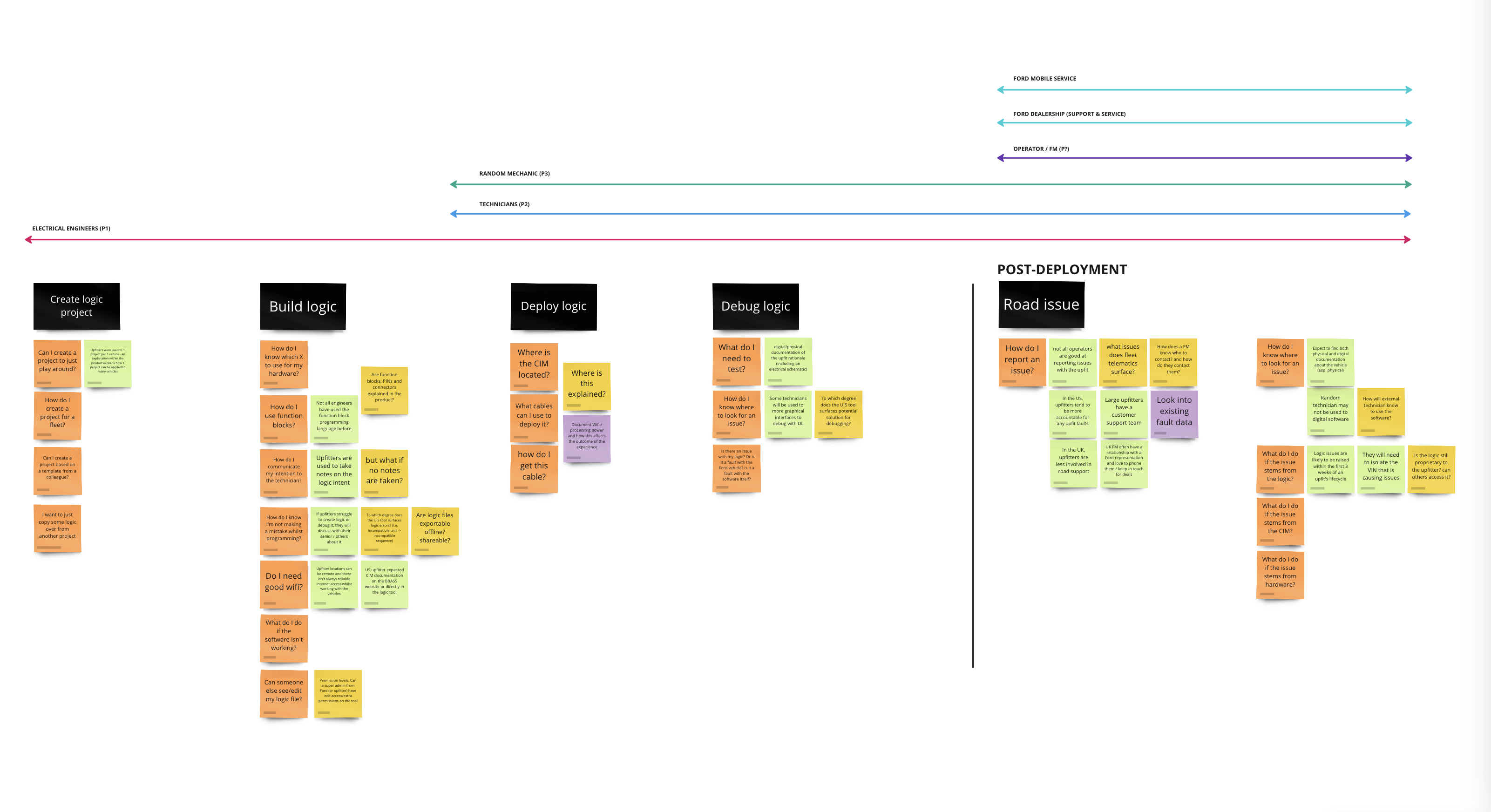
High level Journey Map plotted with support scenarios
Stakeholder what if...? interviews
In order to understand how prepared the business were for these possible support scenarios, I ran a series of 'What if...?' scenario workshops with some of the key teams identified in the actor mapping work.
We approached these sessions with sensitivity and empathy, knowing that the teams were highly stressed and likely to be unaware of and/or unprepared for any gaps that existed.
The intention was to build a clearer picture of what, who and how Ford were prepared to react, so that we could begin to assess where further design support might be required.
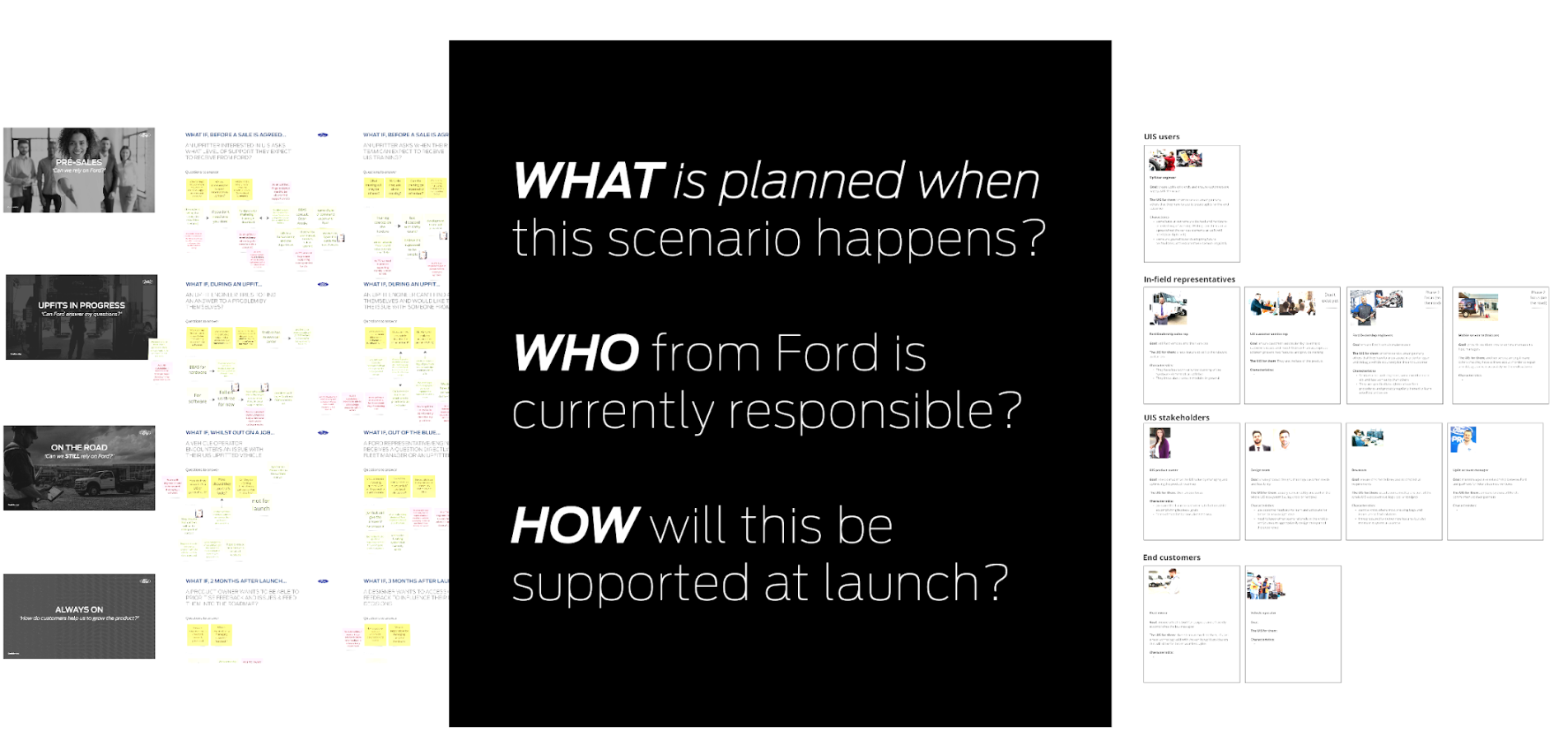
Problem identified
Organisational gap - No team or individual marked as responsible for responding to and owning software support queries
Problem identified
Product owners promising to pick up support queries, despite lack of technical knowledge & no capacity to do so
Problem identified
EU and US teams not aligned on a global support strategy. Multiple conflicting marketing heavy web platforms hinders access to correct support documentation and support channels
Customer needs
Let's speak to some upfitters
After already discovering some quite major backstage issues, we next needed to speak to Upfitters to get a clearer picture of their existing behaviours and expectations of B2B support from Ford.
I worked closely with the Design Researcher to plan and recruit Upfitters for the study (with recruitment being particularly difficult in the end).
Research goals
1. Existing behaviours
When and why Upfitters have required further support when using their current tools and processes during an upfit?
2. Expectations
What level of support do Upfitters expect at various stages of the upfit journey?
3. Preferences
How do Upfitters prefer to get support at various stages of the upfit journey?
Rapid Stimulus ideation
Given the tight timeframe we were working to, I also pushed for the team to begin ideating based on our known problems and working hypothesis. The goal was to quickly create some targeted stimulus to put infront of Upfitters in the research. In addition to being able to use the stimulus in the research, it would also help us to move quickly with any recommendations to the business once we had established the need & priority.
I ran a crazy 8's ideation and voting workshop where the team ideated both Quick Wins & North Star ideas for various user stories that we created for the people involved in the core stages in the upfitting journey.
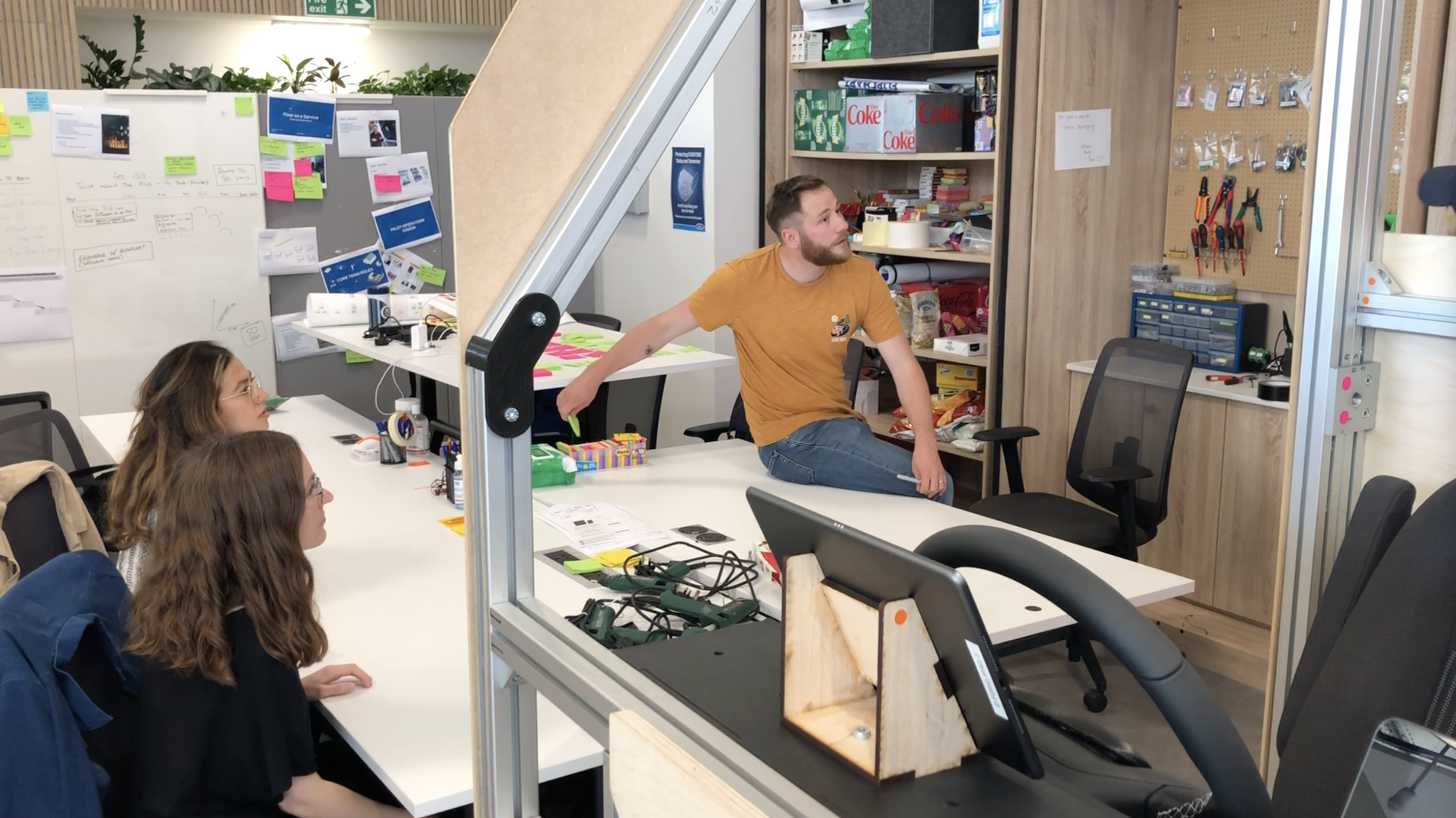
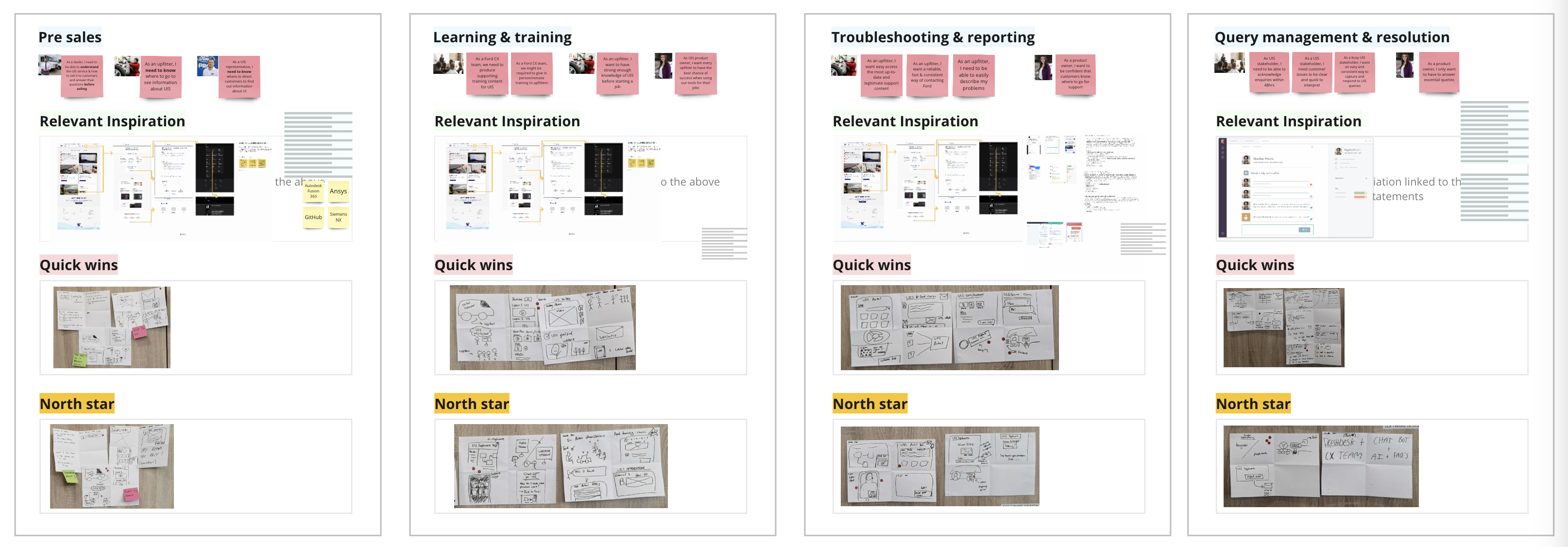
Ideation session output. Key journey stages along with highest voted Quick Win & North Star ideas.
Rapid Stimulus development
The next step was to bring a few of the North Star ideas to life for the research.
We began to conceptualise solutions based on issues already identified within the service and problem statements that we had hypothesised on behalf of the Upfitters. Here's one example.
I produced a concept of a single .com experience acting as a 'one stop shop' for Upfitters. Giving them easy access to digital software and self serve or further support that they might need.
Not only could this be used to aid discussion with Upfitters, but also I could use it to spark discussions with and inspire internal stakeholders.
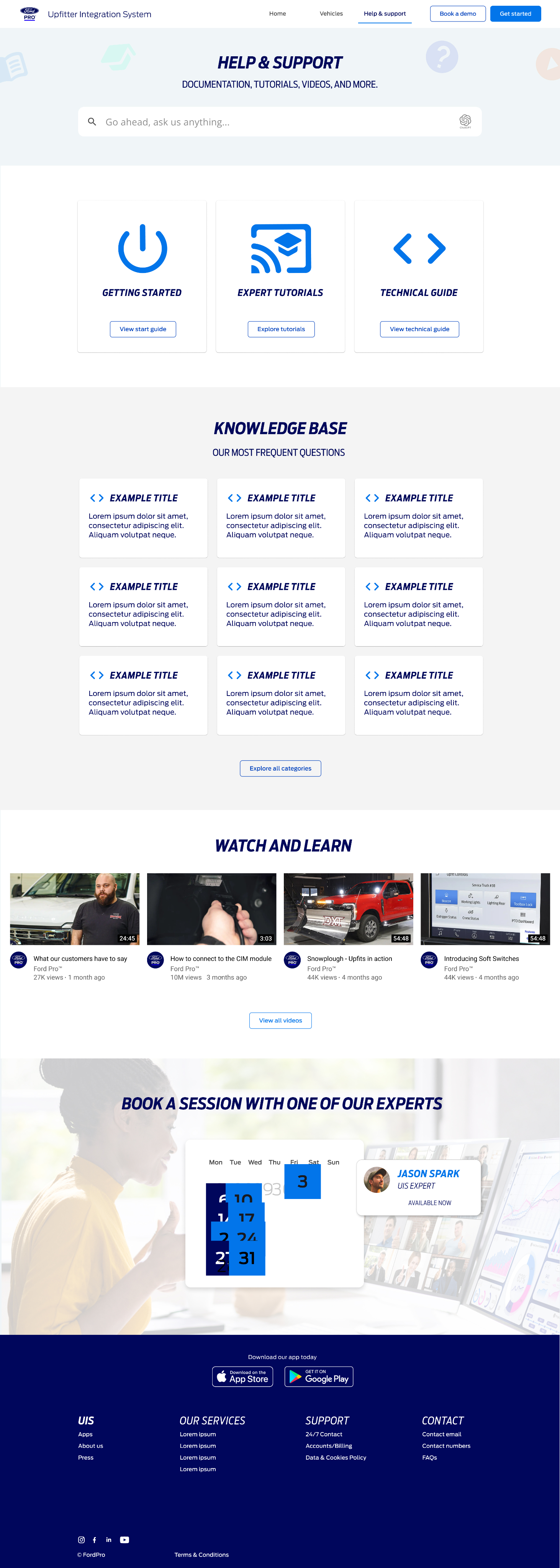
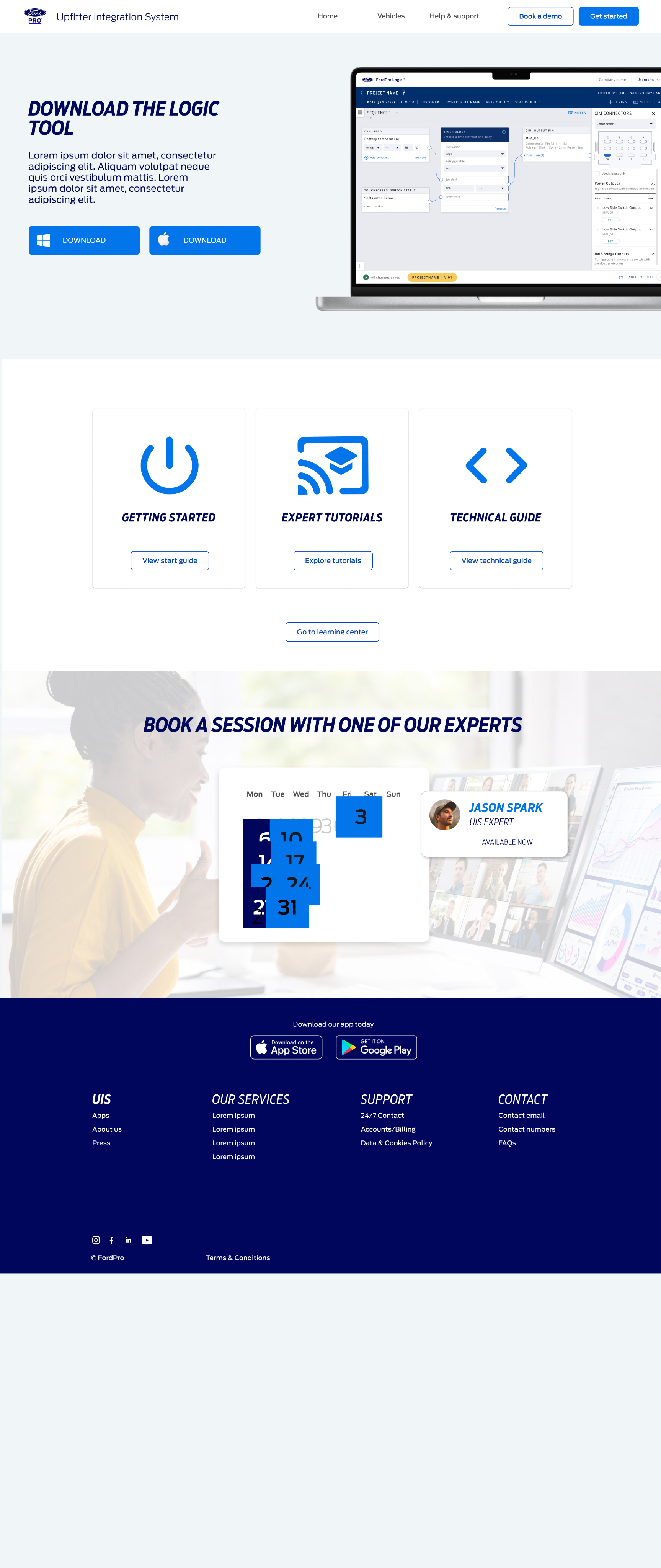
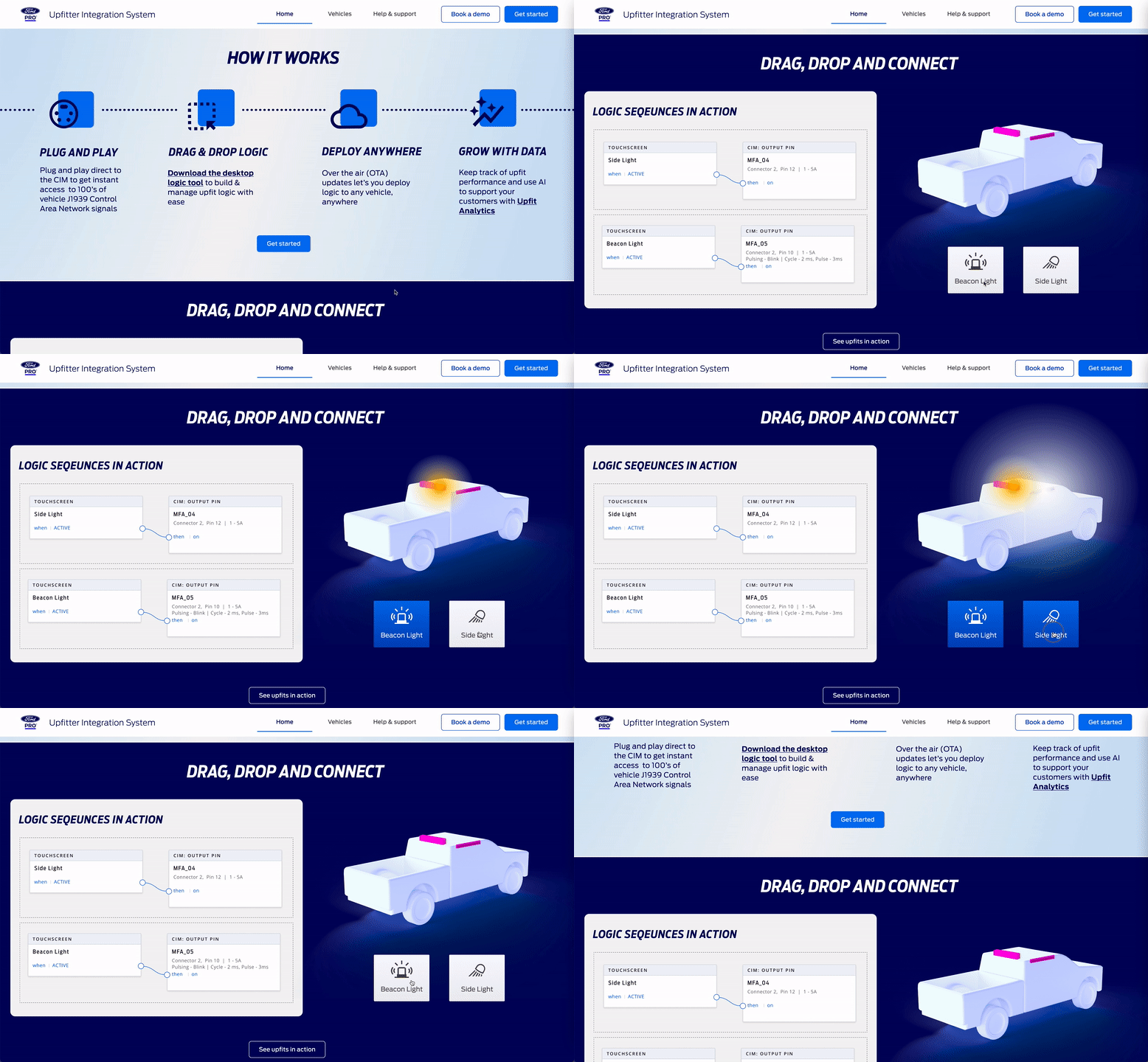
.com experience concept used as research stimulus
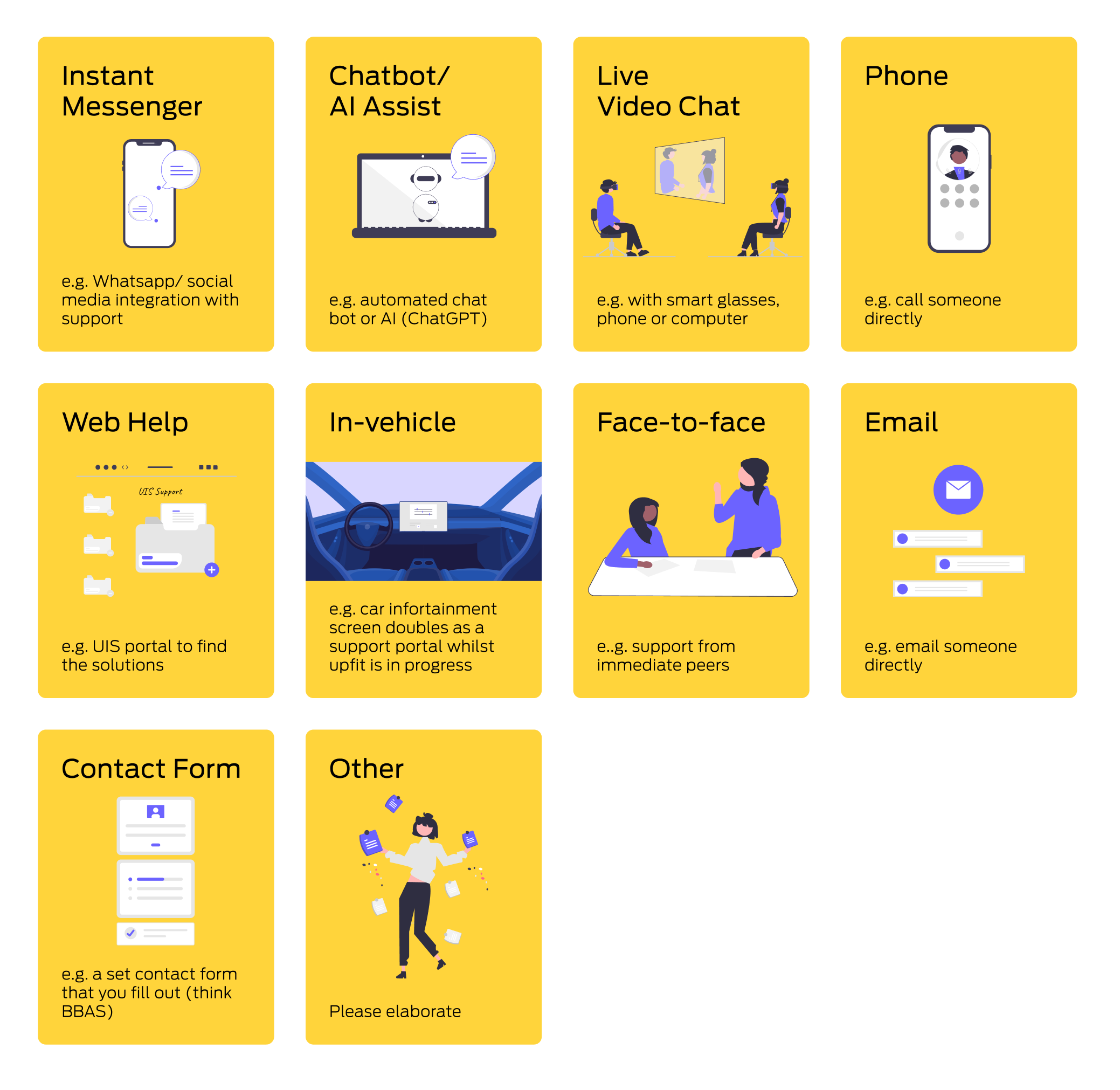
Support option cards used to rank support preferences for various scenarios
Conducting research
I supported our Design Researcher with the in-person and remote sessions through observations, note taking, thematic analysis and general synthesis.
Working closely as a small team meant we could get together and work together to discuss the research sessions quickly.
We spoke to: - 8 x UK Upfitters from 4 different companies (1 x in-person, 7 x remote)
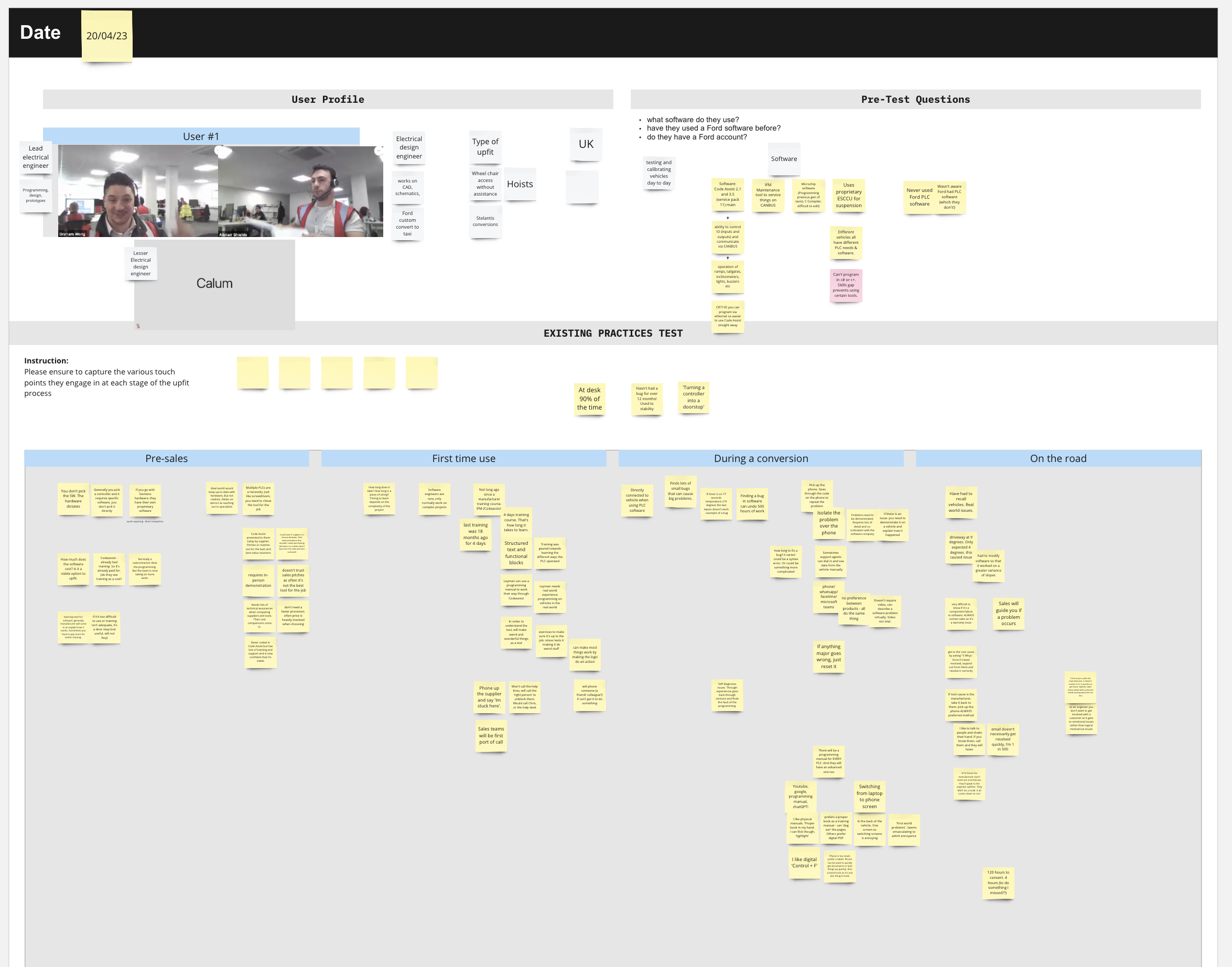
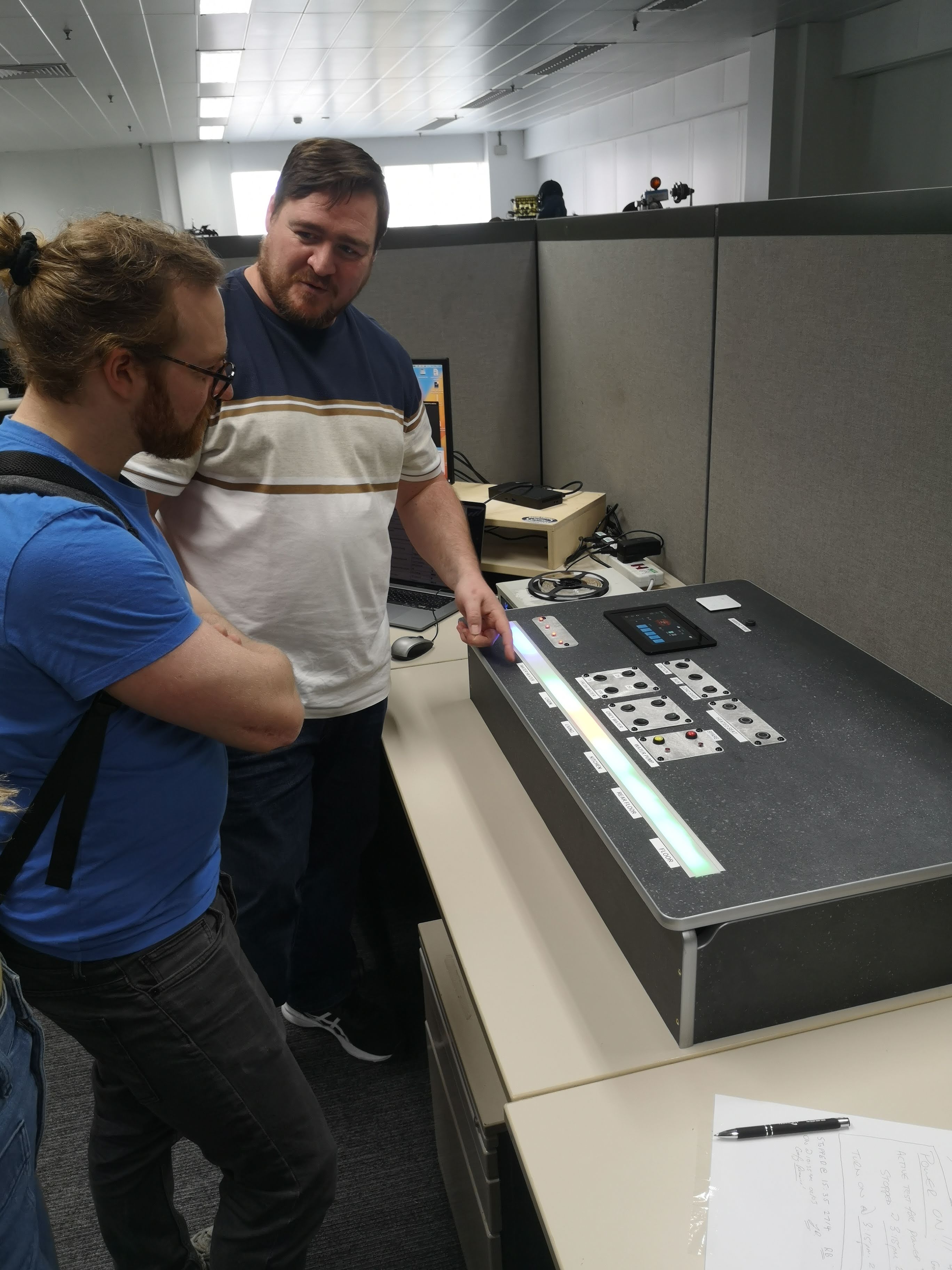
In person & remote research sessions
Linking Insights to problems
Following the study, as a team we synthesised our findings and started to form our key insights and problem statements. Below are a few examples of insights from the customer research that I was able to immediately link to a problem in the service as it existed NOW.
Customer Insight
Being problem solvers at heart, Upfitters will typically opt to try and resolve issues themselves first before escalating for support. However, they still expect a high level of support from B2B service providers. They expect direct contact with a known human to help them to resolve any issues as quickly as possible and avoid delays to their clients.
Problem identified
Organisational gap - No team or individual marked as responsible for responding to and owning software support queries
Problem identified
Scale - The scale of the global service rollout combined with limited Ford headcount means that it would not currently be possible for Ford Representatives to deal with all Upfitter enquiries.
Customer Insight
Upfitters expect thorough and detailed supporting documentation such as Video Tutorials, Technical Guides, User Guides, Online Help Portals BEFORE considering adopting new digital & physical tools AND throughout the use of it.
Problem identified
EU and US teams not aligned on a global support strategy. Multiple conflicting marketing heavy web platforms hinders access to correct support documentation and support channels
Problem identified
No plan to produce ANY support documentation in time for launch. Unclear what team would even be responsible for this.
Now, Near and Far
Telling a difficult story
After getting a firm understanding of the end-to-end journey from both the customer & businesses perspective I could begin to think about how to play this back to the business in the most appropriate format.
There was the potential for some strong emotions within the narrative and I felt that the best way to play with back initially was to build out a set of lo-fi story boards to bring the current state of play to life.
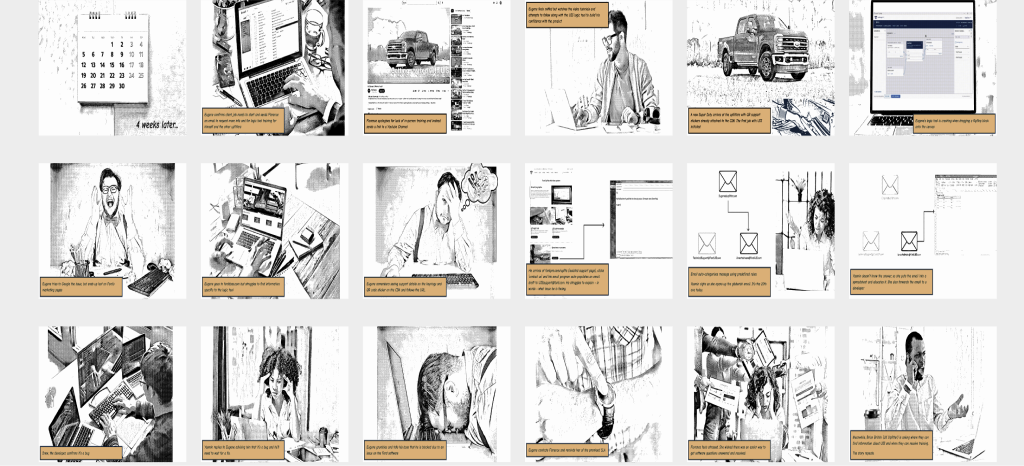
Lo-fi storyboards
With the help of a perfectly toned team member to voice over the story, we presented back our findings back to key stakeholders. Storyboarding proved a great way to focus in on the customer and front/backstage people & processes to the forefront.
As great as storyboarding is for capturing the attention of an audience, it can be forgotten about as soon as people leave the meeting. This is not something we could really risk. I needed to pull all of the work together into a single document that could be easily referenced even by C-level Executives.
NOW, NEAR and FAR. all in one place
I had been working on a lo-fi service blueprint throughout the project, but I knew from experience that this sort of document would be far too complex for the job (and audience).
I created a framework to plot the fundamentals of a service blueprint onto a neater, more scanable map.
I mapped the NOW, NEAR and FAR journeys using 'Upfitter emotion' as the main scale. This approach allowed me to demonstrate how each detrimental knock to the Upfitters emotions could continue to drop into an overall negative experience for the Upfitter.

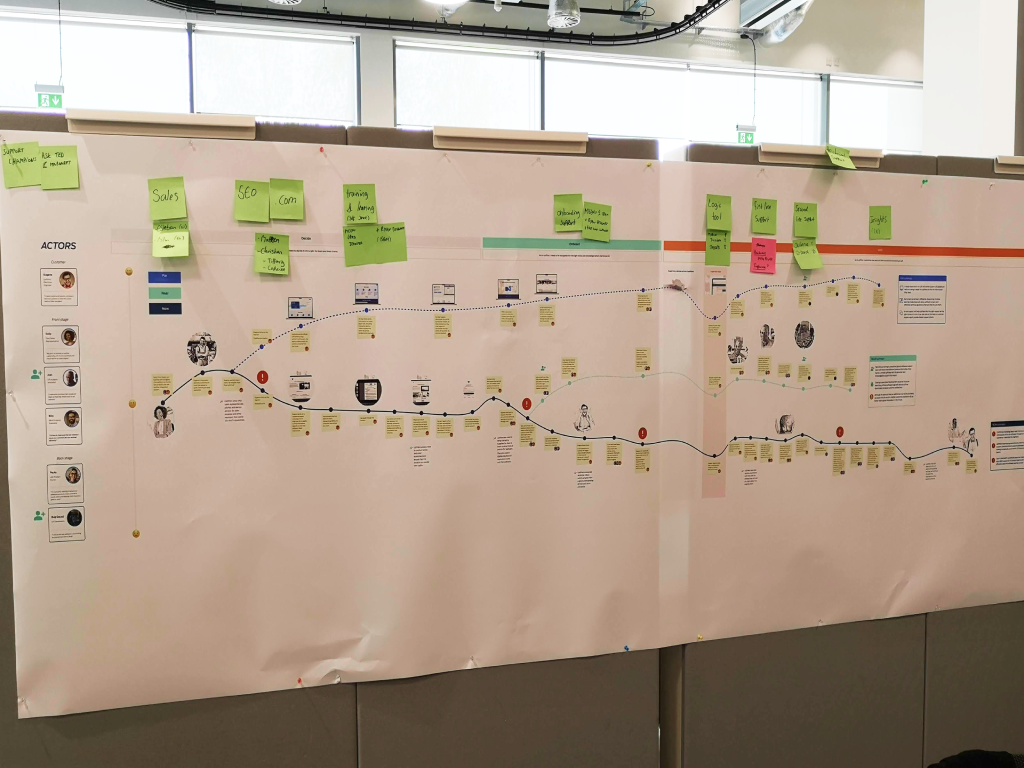
Journey Map proudly in use in the workspace
Mapped onto the 3 different timelines were key actions, the actors involved and any relevant insights to justify it's position on the map. The major issues could be identified quickly along with the stage of the journey that they occur.
On the NEAR timeline I was able to clearly identify 'quick-fix' opportunities to some of the biggest issues (typically these were defining moments). Here is where the experience could 'splinter' and we could visualise how certain interventions could start to improve the trajectory.
Given it was a matter of weeks until launch, the NEAR timeline was our main focus so that we could give the business something realistic to action. The FAR timeline was a way for us to push the ideal journey, highlighting the various improvements required to make that happen.
Influencing up
Ford being a huge global company, it's not as simple as making a nice Journey Map and hoping it makes a difference. I had to plan a route for this work to land at the right level. This meant mapping out an org chart to show all FordPro departments and management levels upwards. This showed us who needed to be made aware of our findings and who could take accountability and help resolve some of the must fixes.
There were some pretty major organisational issues that had been discovered as part of this work so it seemed inevitable that the work would need to make it's way up the chain to C-Level.
I led the team through various shares and marked their 'awareness' of the work on the Stakeholder Engagement Plan (Red = Not aware | Amber = Some awareness | Green = Aware)
Eventually it was taken by our senior champions direct to the FordPro CEO, but that was a mark of a success for our team in terms of impact.
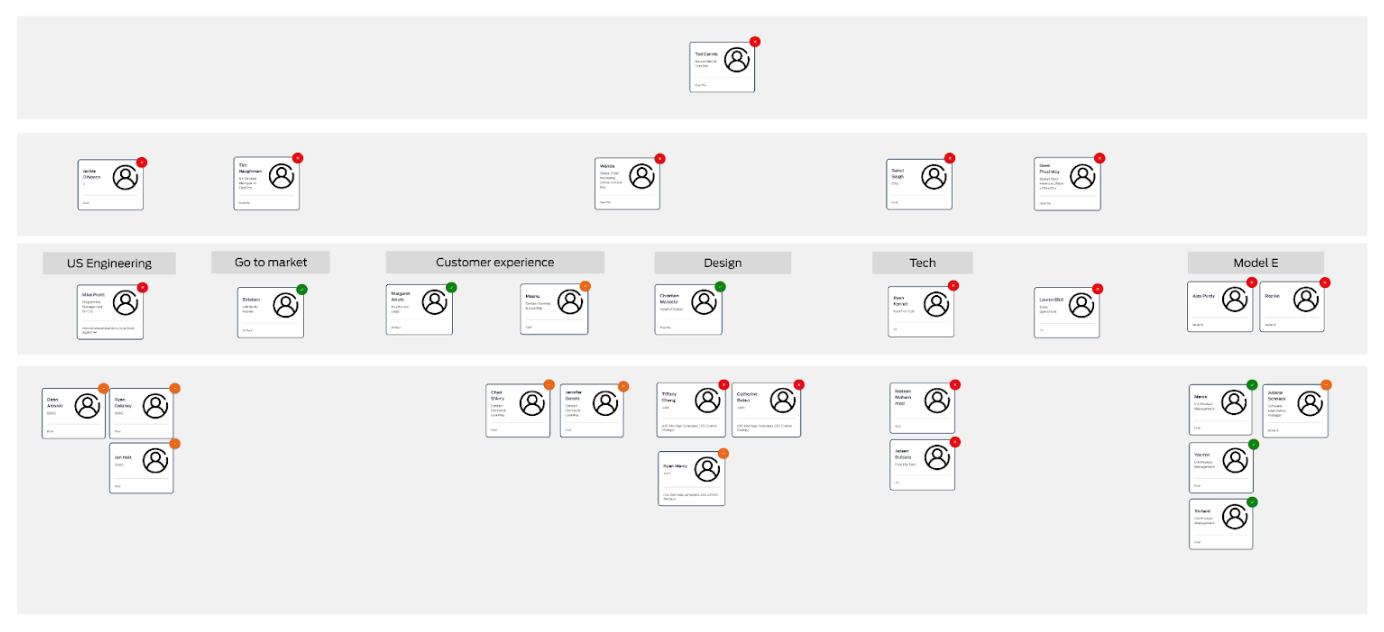
Stakeholder Engagement Plan
Feeding into the roadmap
Next, I worked with the product teams to document, rank & prioritise and track issue and suggestions from this work. This started as an Excel issues list that eventually became the digital issue tracker for the service. From here, Product Owners and Managers were able to prioritise these issues & suggestions against their current backlog items prior to launch. As always, it was our job to ensure the customer was represented in this and any problems found were clearly articulated.
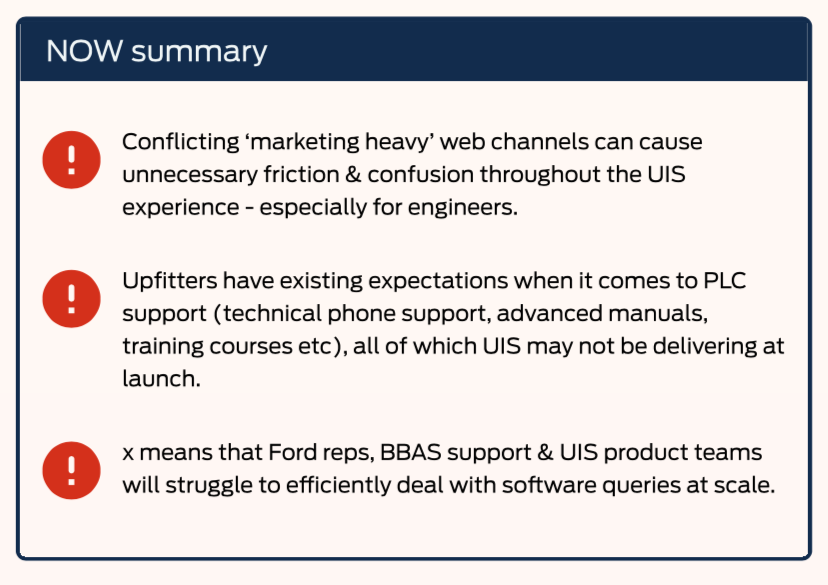
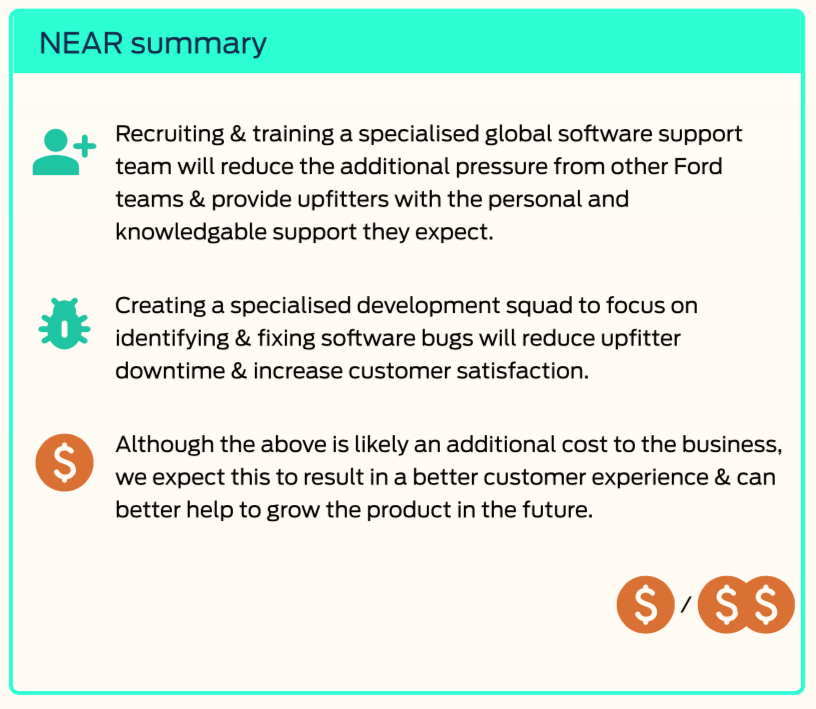
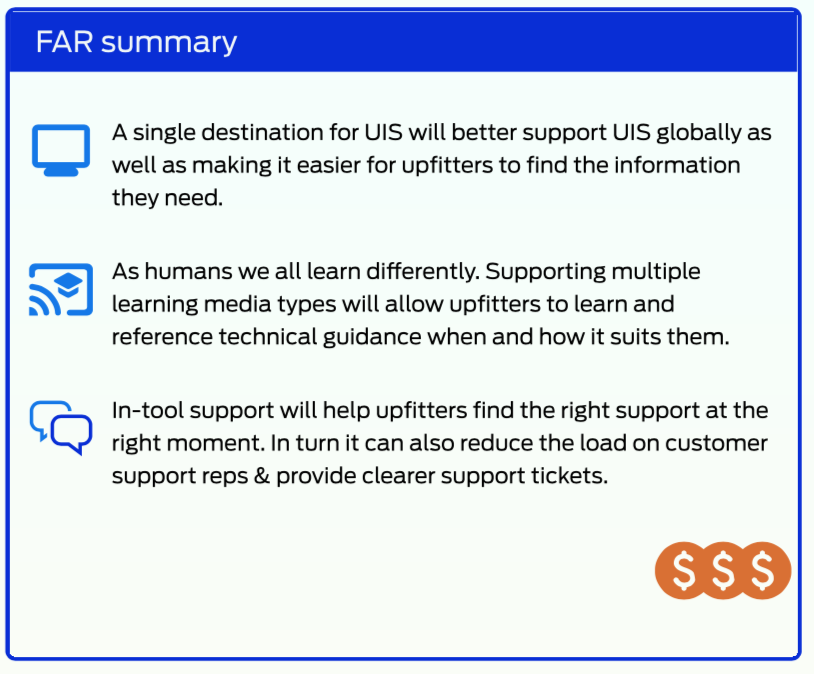
Outcome
From no priority to the highest priority
Before I started this work, 'post-sales support' was on the bottom of the priority the list.
Once our work began to make it's way up the chain, eyes started to open and I think it's safe to say bit of panic kicked in (even at leadership level).
Fortunately we came armed with a carefully considered, validated and human-centered list of actions for the business to react to.
What we achieved in time for launch

A priority redesign of the .com experience


A series of essential user guides, technical guides & video tutorials

A single customer support destination and an agreed support team

A healthy list of items added to the backlog for future work

A Journey Mapping framework that's been adopted by the wider HCD team

A true appreciation from the business for doing this kind of work
Project reflections & feedback
"I know it's been a challenging project at times getting any movement within the business, but please be proud that the seeds of doubt that we sewed throughout our work did get recognised and became a high priority for the business. For our upfitters it's going to make a whole world of difference. We listened to them, we empathised with them and we helped them."
Me - Workstream Design Lead
"Good design is not making thing shiny, but indeed solving real problems for our customers. Fantastic work team!"
Interaction Design Director - D-Ford London
The Launch
It's out in the wild, but this is just the beginning...
The Upfit Integration System launched in the Summer of 2023 to thousands of Upfitters across North America.
The core team now begins the journey of supporting & growing the service, as well as preparing for a European launch in the very near future.



More work